AI search attribution
AI visibility is not the finish line. Customers are.
SEOforGPT connects the signals you can observe: whether AI answers mention and cite your brand, whether AI systems reach your pages, which assistants send identifiable visits, and what those visitors do next in analytics.
AI search attribution is the practice of measuring the observable path from visibility in an AI answer to crawler activity, referral sessions, on-site actions, pipeline, and revenue—while separating direct evidence from influence that cannot be identified reliably.
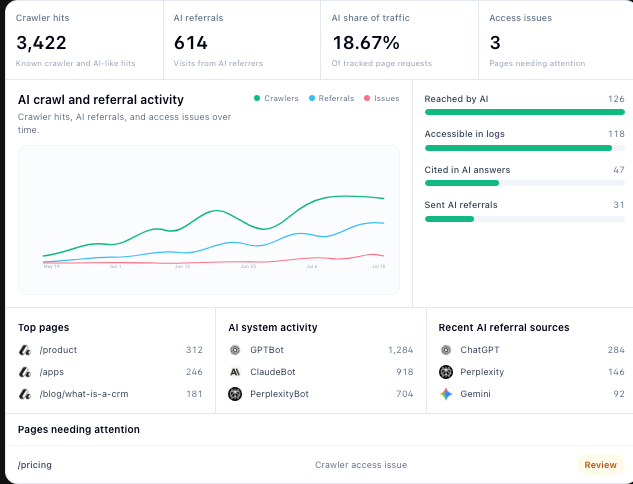
Measurement framework
The AI demand evidence ladder
One metric cannot explain AI demand. A useful attribution system keeps five layers separate, then reads them together. That prevents a visibility score from being reported as traffic—or an identifiable referral from being treated as the whole market.
LAYER 01
AI visibility
Mentions, recommendations, rank, and citations across a stable prompt set.
- What you can measure
- Which brand appears, where it appears, which source is cited, and how results change.
- Where SEOforGPT helps
- Prompt monitoring, answer-level evidence, competitor share, rank, and citation tracking.
- What remains uncertain
- A visible mention does not show whether a person saw, trusted, or clicked it.
LAYER 02
Machine discovery
Requests from known AI search, retrieval, training, and user-triggered agents.
- What you can measure
- Which crawler reached which page, when it arrived, and whether the request succeeded.
- Where SEOforGPT helps
- Crawler activity, provider categories, landing paths, blocked requests, and access issues.
- What remains uncertain
- A crawler hit does not prove indexing, citation, a surfaced answer, or human demand.
LAYER 03
Identifiable demand
Human visits that retain a recognizable AI-assistant referral signal.
- What you can measure
- Sessions, provider, landing page, engagement, and visit trend for known referrals.
- Where SEOforGPT helps
- AI referral visits beside crawler activity, provider trends, and landing-page evidence.
- What remains uncertain
- Copied URLs, later direct visits, zero-click answers, and some apps remain dark.
LAYER 04
On-site action
Engaged sessions, key events, sign-ups, demos, purchases, and qualified actions.
- What you can measure
- Conversion rate and action quality for identifiable AI sessions in analytics.
- Where SEOforGPT helps
- SEOforGPT shows the incoming evidence; your analytics platform records the next action.
- What remains uncertain
- An action after a visit is attributable under a model, not proof of singular causation.
LAYER 05
Customer value
Pipeline, closed revenue, repeat value, and self-reported AI discovery.
- What you can measure
- Revenue assigned by analytics plus CRM source, opportunity, and customer records.
- Where SEOforGPT helps
- Use SEOforGPT evidence to explain the demand context around downstream reporting.
- What remains uncertain
- Closed-loop value depends on your analytics and CRM hygiene, not visibility data alone.
Read each signal correctly
Visibility is not traffic
A mention is evidence that a brand appeared in an observed answer. A citation shows that an answer linked to a source. Neither is a session. A referral session is stronger traffic evidence, but it still does not reveal the private prompt or prove that the visit caused a purchase.
Mentions and rank: Use them to find demand gaps and compare answer presence over a stable prompt set.
Citations and sources: Use them to learn which pages and third-party sources support an answer.
Crawler activity: Use it to diagnose discovery, retrieval, access, and page-level technical issues.
AI referral sessions: Use them to evaluate identifiable traffic quality by provider and landing page.
Direct attribution is the observable click and its downstream record. Assisted or “dark AI” discovery includes zero-click exposure, copied links, later direct visits, and conversations that never pass a referrer. Report the two separately.
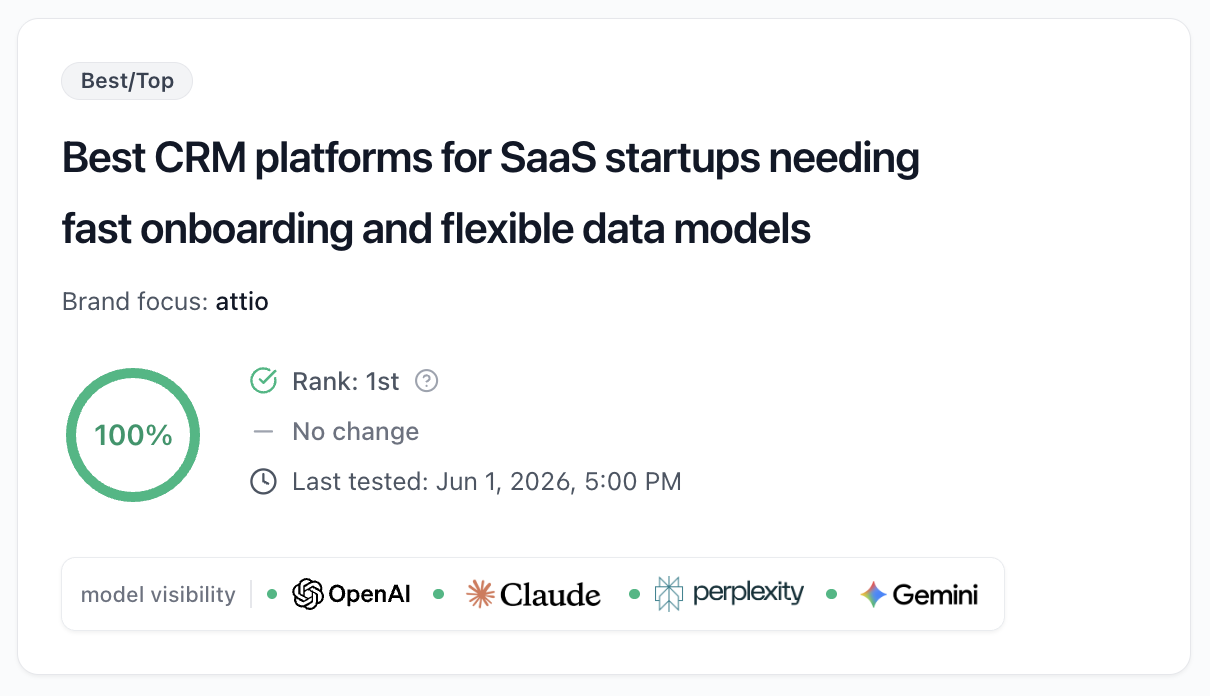
Crawler and referral evidence
See which AI systems reach and send visitors
SEOforGPT’s crawler analytics separates machine activity from human referral traffic. See recognized search and training crawlers, user-triggered fetches, provider activity, landing pages, identifiable AI referrals, and requests that were blocked or failed.
That distinction matters. GPTBot reaching a page is different from a person arriving from ChatGPT. A failed crawler request is an access problem; a high-traffic landing page with weak engagement is a message problem. They lead to different decisions.
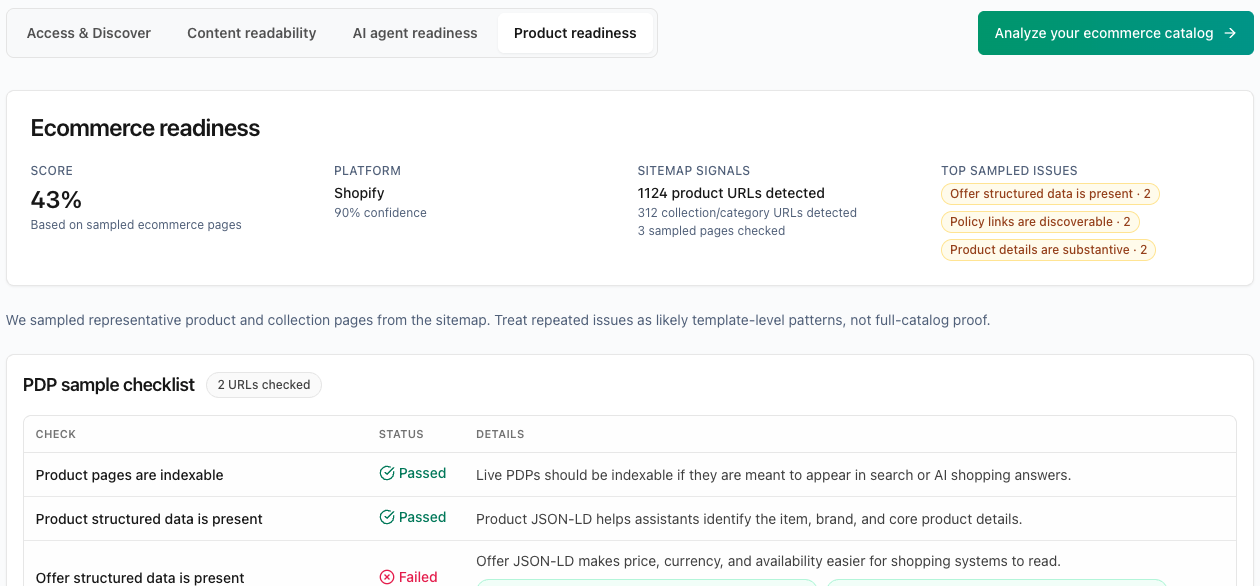
Analytics workflow
Connect referrals to conversions
Google Analytics now recognizes supported AI-assistant traffic in its AI Assistant default channel. For a current visit, use session-scoped acquisition dimensions. Use first-user acquisition when the question is how the person was originally acquired—not what sent the present session.
- 1Open Traffic acquisition and filter or compare the AI Assistant default channel.
- 2Use Session source / medium and landing-page dimensions for the current visit.
- 3Add engaged sessions, key events, purchases, or revenue that your implementation records.
- 4Compare provider and landing-page quality, then annotate the attribution model and reporting window.
Board-safe measurement
The metrics a CMO should report
Keep leading indicators, traffic, conversion, and revenue in separate rows. This creates a useful narrative without manufacturing a formula that says a prompt result caused a sale.
| Evidence group | Report | System of record |
|---|---|---|
| Leading indicators | Prompt coverage, mention rate, recommendation rate, citation rate, average rank | SEOforGPT |
| Machine discovery | Crawler hits, pages reached, success rate, blocked or failed requests | SEOforGPT |
| Traffic evidence | Identifiable AI referral sessions, providers, landing pages, engagement | SEOforGPT + analytics |
| Conversion evidence | Key events, trials, purchases, AI referral conversion rate | Analytics |
| Commercial value | Attributed revenue, pipeline, closed-won value, self-reported discovery | Analytics + CRM |
Identifiable AI referral sessions
Count sessions classified as AI Assistant or matched to a maintained list of recognizable AI referrers.
AI referral conversion rate
AI referral sessions with the selected key event ÷ identifiable AI referral sessions × 100.
AI-attributed revenue
Revenue assigned to identifiable AI traffic under the named analytics attribution model and date range.
AI landing-page engagement
Engaged AI referral sessions ÷ identifiable AI referral sessions, segmented by landing page.
Practical implementation
A 30-day measurement setup
You can establish the baseline without buying new software. The goal of the first month is not perfect attribution; it is consistent definitions, verified inputs, and a report your team can repeat.
Week 1
Define stable buyer prompts
Choose high-intent questions, record your brand and competitors, and capture mentions, rank, recommendations, and citations without changing the sample mid-period.
Week 2
Verify machine discovery
Review server or crawler analytics, classify known agents, confirm priority pages are reached, and resolve blocked or failed requests before interpreting absence.
Week 3
Validate analytics
Confirm GA4’s AI Assistant reporting, session-scoped acquisition fields, landing pages, key events, revenue, and internal filters. Document your attribution model.
Week 4
Read the layers together
Compare visibility gaps, crawler access, referral quality, and conversion outcomes. Choose the next page or technical fix from evidence—not from one blended score.
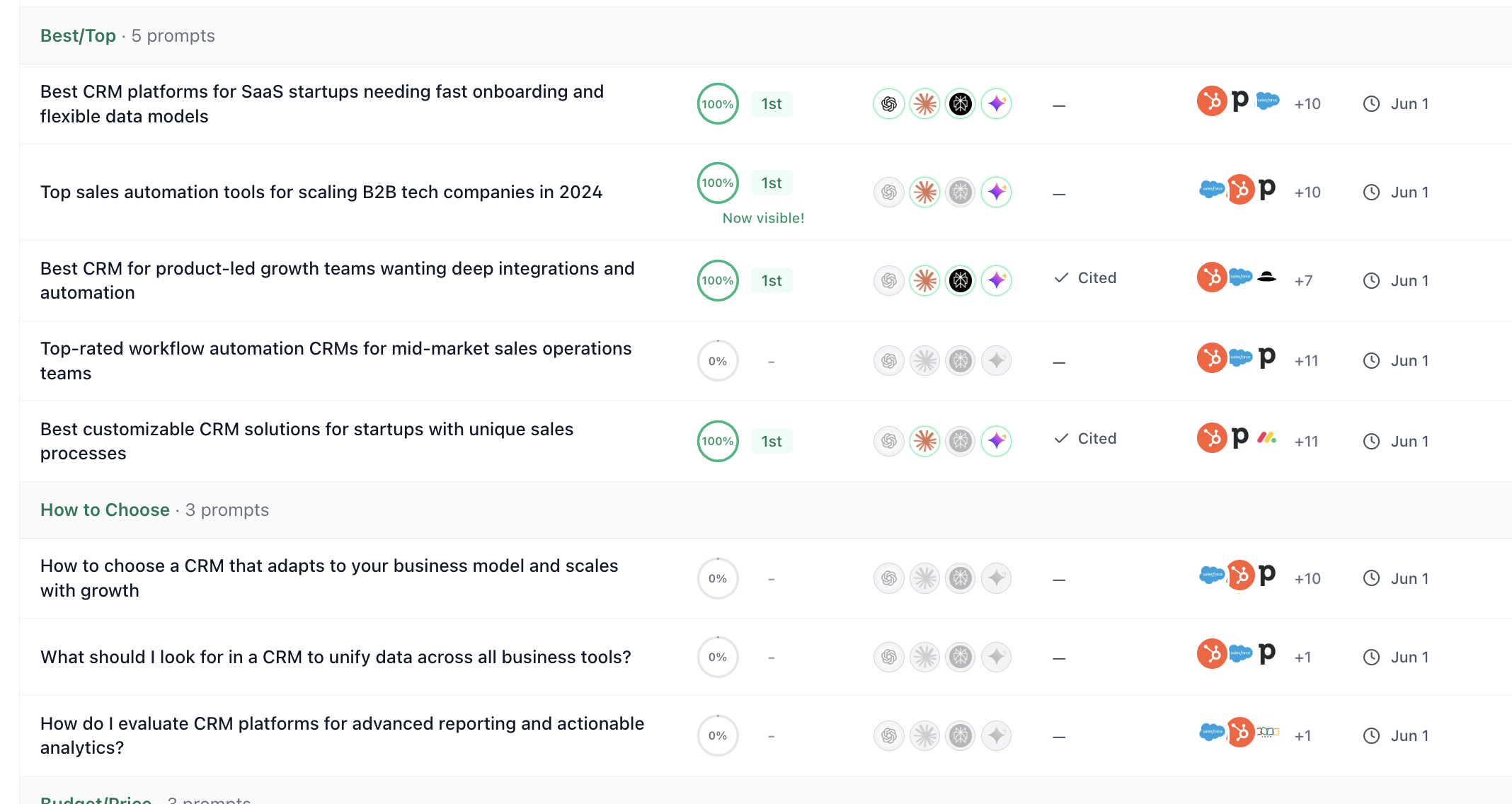
From report to decision
What to do with the evidence
The value of attribution is not the dashboard. It is choosing the right intervention for the broken layer.
Visibility without crawls
Check robots policy, rendering, canonicals, indexability, and whether priority pages are reachable.
Crawls without citations or referrals
Strengthen the direct answer, original evidence, entity clarity, and source quality on the pages being reached.
Referrals without conversions
Align the landing-page promise, proof, offer, and next action with the question that likely brought the visitor.
Conversions without clean attribution
Add self-reported discovery to high-value forms and preserve source fields through the CRM lifecycle.
Strong pages
Use their topic, format, cited evidence, and landing-page path to prioritize the next content cycle.
Attribution questions
Frequently asked questions
Can ChatGPT traffic be tracked?
Yes, when a visit arrives with a recognizable ChatGPT referrer or is classified by your analytics platform as AI-assistant traffic. Copied URLs, later direct visits, some in-app journeys, and zero-click answers may not retain that evidence.
Does GA4 identify AI assistants?
GA4 now includes an AI Assistant default channel for recognized traffic. Use session-scoped acquisition dimensions to study the current visit and first-user dimensions when you need the original acquisition source.
Can an AI referral be connected to the original prompt?
Usually not. Referral data can identify the assistant and landing page, but providers generally do not pass the private conversation or exact prompt to the destination website.
Why does AI traffic sometimes appear as direct traffic?
The referrer can be lost when someone copies a URL, changes device, returns later, uses an app that suppresses referral data, or moves through another privacy-preserving handoff.
What is the difference between crawler traffic and human referral traffic?
Crawler traffic is a machine request used for discovery, retrieval, search, or training. Human referral traffic is a person clicking through from an AI assistant. A crawler visit does not prove a human saw or clicked the page.
Can SEOforGPT prove that an AI recommendation caused a sale?
No. SEOforGPT can show visibility, citations, crawler activity, and identifiable referrals. Analytics or CRM data can record later actions, but those signals do not prove that one recommendation caused a sale.
Which AI platforms can send identifiable referrals?
Recognizable visits may arrive from assistants such as ChatGPT, Perplexity, Gemini, Claude, Copilot, and other AI experiences. Identification depends on the provider, surface, browser, and referrer preserved for that visit.
How should AI search ROI be reported?
Report visibility and citations as leading indicators, identifiable AI sessions as traffic evidence, key events as conversion evidence, and attributed revenue under a named analytics model. Keep assisted or self-reported discovery separate.
Measure what happens after AI visibility
Build a defensible view of visibility, discovery, identifiable referrals, and customer action—without claiming the dark part of AI discovery is fully attributable.