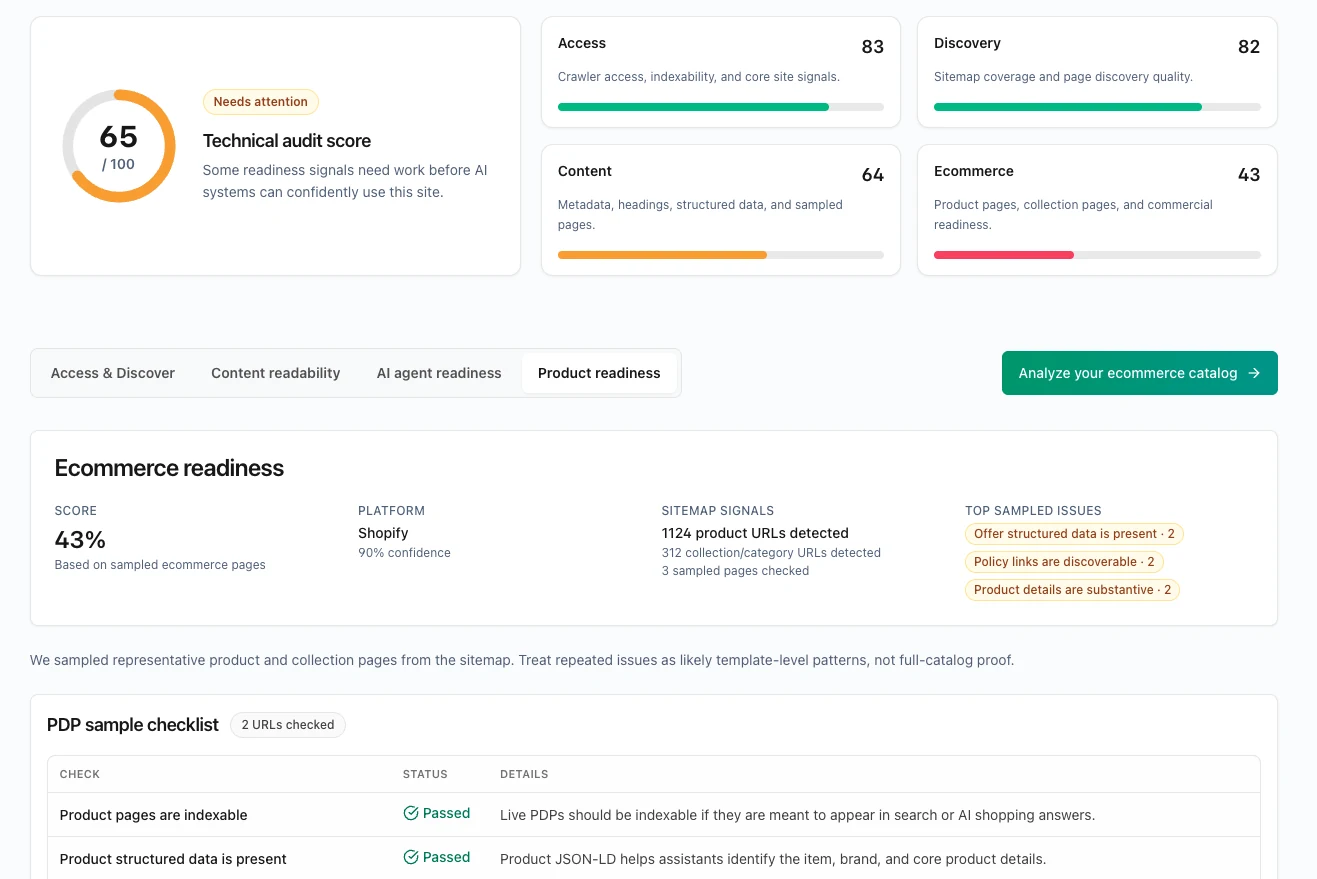
01Discovery
Shoppers ask for the best products for a need, audience, budget, or occasion.
Track whether your products are mentioned when shoppers ask AI for recommendations, comparisons, compatibility, or buying advice. See which products, competitors, and sources shape the shortlist, identify technical and content gaps across product and category pages, and turn the findings into prioritized actions.
The new product discovery journey
AI shopping starts with questions, not SKUs. Brands need pages that can answer those questions clearly and evidence that earns a place in the response.
Shoppers ask for the best products for a need, audience, budget, or occasion.
They ask what differs, what fits, and which trade-offs matter before building a shortlist.
Clear product facts, buying guidance, reviews, policies, and citations reduce ambiguity.
Track whether your products appear and which competitors and sources appear instead.
Catalog audit
The audit separates machine-readability problems from the information a shopper needs to choose. That makes the fix list useful to developers, merchandisers, and content teams.
Can an AI system identify the offer and understand who should buy it?
Can an AI system understand the range and help a buyer choose within it?
Inside the ecommerce audit
The audit keeps every level connected: understand overall readiness, choose the pages that matter, then open any result to see what failed, why it matters, and how to verify the fix.
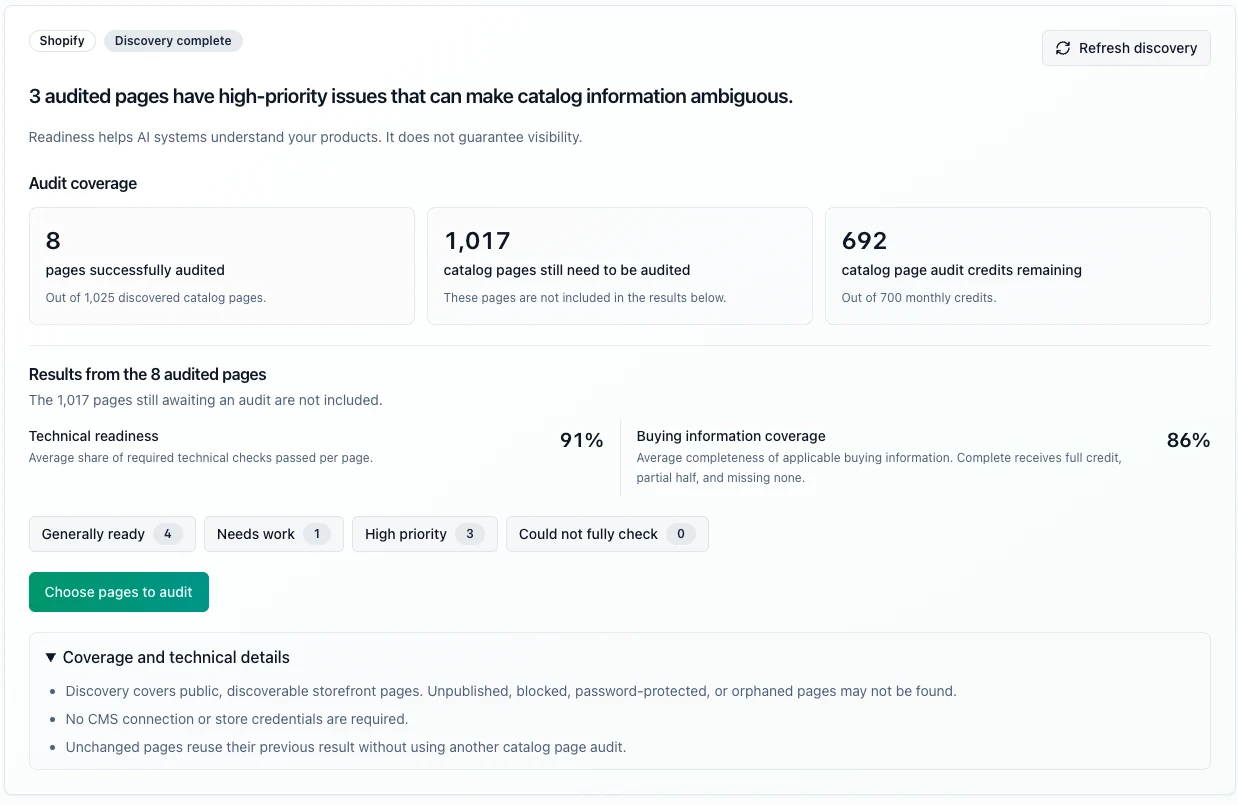
01
See how much of the catalog has been discovered and audited, compare technical readiness with buying-information coverage, and separate high-priority pages from pages that are generally ready.
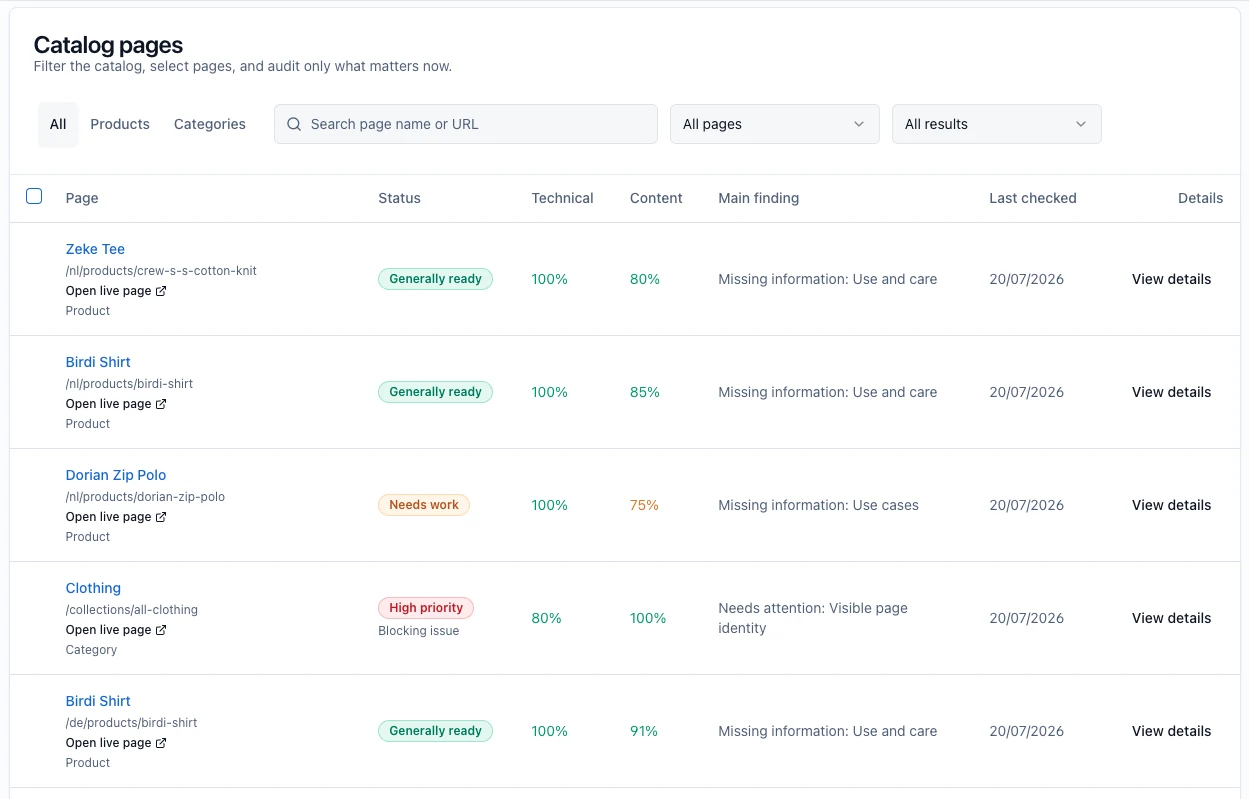
02
Filter the catalog, compare technical and content scores, and find the main issue on each product or category page before opening the full diagnosis.
03
Every blocking finding explains what was found, why it matters, how to fix it, where to make the change, and how to verify the result.
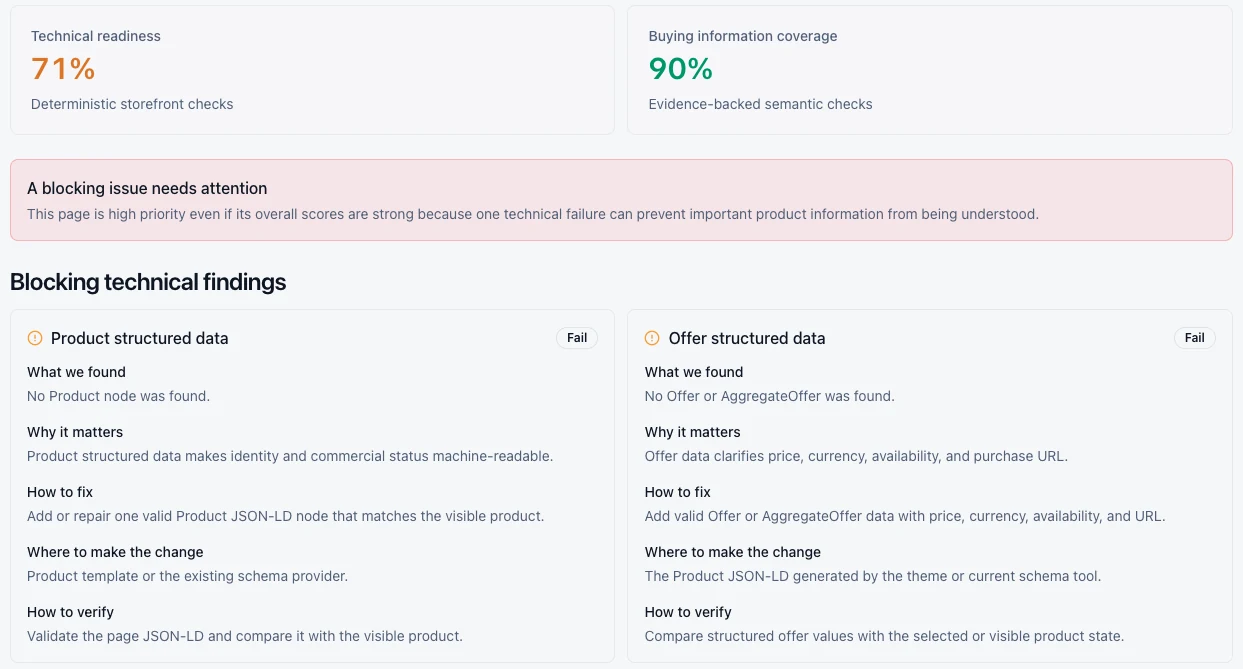
Illustrative audit using demo catalog data.
Content is product data with meaning
Structured data helps machines identify a product and its offer. Useful page content supplies the audience, use case, trade-offs, proof, and selection logic needed to evaluate it.
Readiness improves how clearly systems can understand your products. It does not guarantee that an AI model will mention or recommend them.
From diagnosis to measurement
Fix the highest-leverage patterns first, then measure whether stronger pages change how your brand appears in buyer conversations.
Discover public product and category pages from your verified storefront.
Evaluate technical readiness and buying-information coverage at catalog scale.
See which issues recur and how many pages each recommendation affects.
Give developers, merchandising, and content teams precise evidence and guidance.
Verify whether the intended fixes are now present and readable.
Track recommendations, competitors, and cited sources across four engines.
Readiness meets real-world visibility
Track the buyer questions that matter, compare visibility with competing brands, and inspect the sources shaping each answer.




Monitor discovery, comparison, compatibility, and purchase-intent questions.
See which brands are mentioned when yours is absent or outranked.
Find the publications, reviews, and pages that influence AI answers.
Ecommerce Audit is available on eligible paid plans. Catalog-page allowances vary by plan.
Compare brand plansSee monitoring, analysis, content, and reporting in one place.
Use SEOforGPT workflows to prioritize changes with your existing tools.
Learn how to create evidence-rich content around buyer questions.
Build a practical measurement program for AI discovery and recommendations.
Practical answers about catalog auditing, content, monitoring, and plans.
It checks whether the page is accessible and correctly identified, whether Product and Offer data agrees with visible price and availability, and whether the page explains purpose, audience, use cases, benefits, specifications, compatibility, selection guidance, care, shipping, and returns.
It checks indexability, canonical URLs, visible category identity, crawlable product links and pagination, plus category scope, intended customer, selection criteria, product differences, and useful buying guidance.
Structured data identifies products and offers. Written content explains who a product is for, why someone should choose it, how it differs, and which constraints or evidence matter. AI shopping answers need both facts and decision context.
Yes. It maps public, discoverable catalog pages from a verified storefront. Password-protected, inaccessible, or orphaned pages may not be discoverable.
No. Readiness makes products easier to access and understand, but no audit can guarantee a mention or recommendation. SEOforGPT separately monitors real answers to show what is happening.
SEOforGPT monitors buyer prompts across ChatGPT, Claude, Perplexity, and Gemini.
SEOforGPT audits public, discoverable storefront pages when the store and ecommerce catalog can be verified. The audit evaluates page evidence rather than relying on a single commerce platform.
Ecommerce Audit allowances vary by eligible paid plan. The current limits and plan comparison are available on the pricing page.
Measure your current visibility first, then use the catalog audit to prioritize the pages and evidence that need work.
Check my AI visibilityNo guarantee language. Just evidence, priorities, and measurable AI visibility.
We use cookies to enhance your experience, analyse site traffic and measure advertising. Read our Cookie Policy