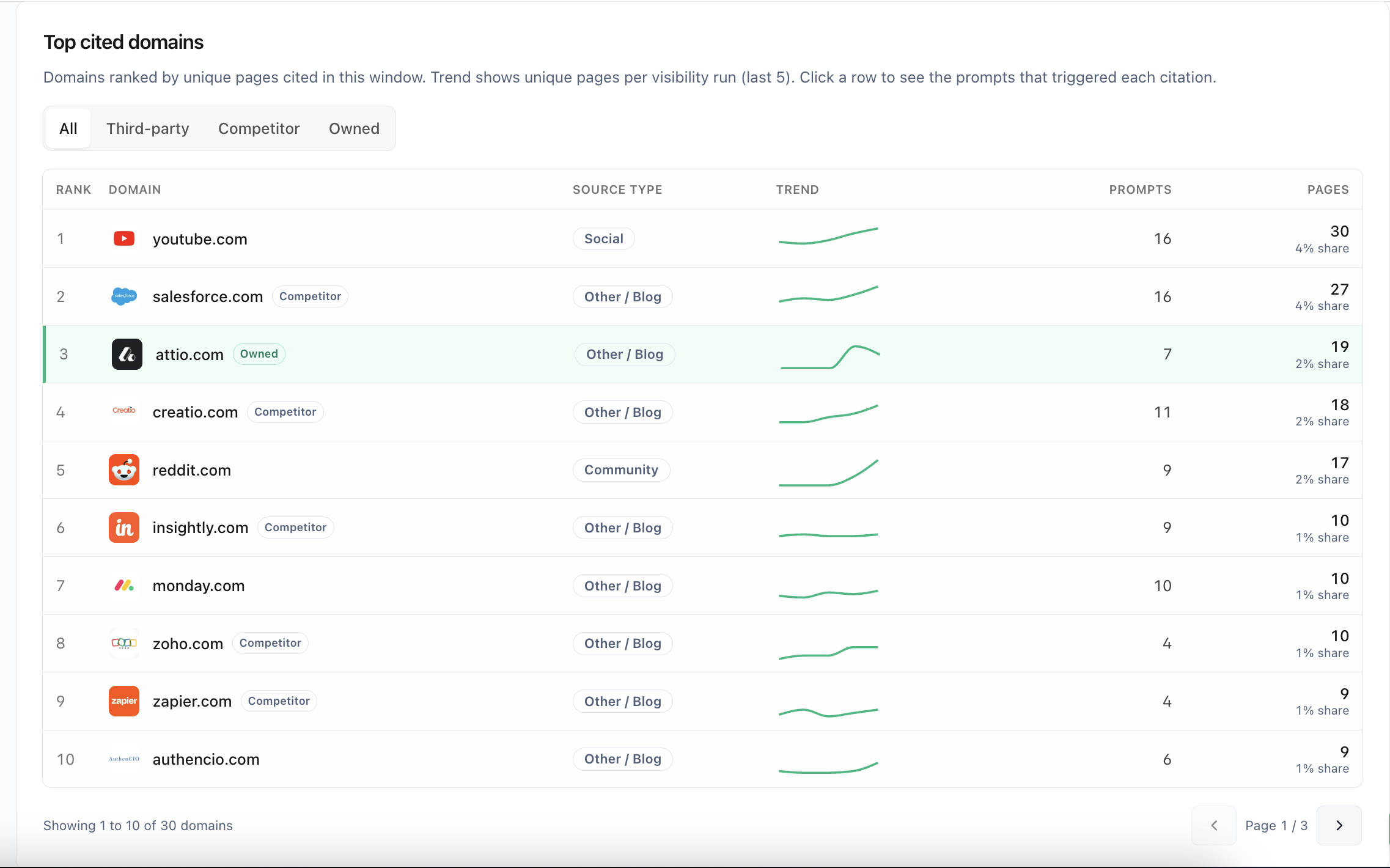
What you are seeing
Rank cited domains and watch their trend
Compare unique cited pages, prompt coverage, source type, and recent movement across owned, competitor, community, and third-party domains.
Open full-size product screenshotFind the domains and pages surfaced as evidence across monitored answers. Connect every citation to the prompt, model, ownership type, trend, and answer outcome your team needs to review.
Sources
The sources AI pulls from, crossed with who won each answer.
Unique citations
1,015
Unique domains
562
Owned citations
28
Prompts supported
19
| Website | Cited pages |
|---|---|
 YouTube youtube.com | 36 |
 Salesforce salesforce.com | 36 |
 Attio attio.com | 28 |
 reddit.com | 27 |
 Creatio creatio.com | 20 |
Top cited domains
Domains ranked by unique pages cited in this window.
youtube.comSocial+500%17364% sharesalesforce.comCompetitorOther / Blog+620%16364% shareattio.comOwnedOther / BlogN/A9283% sharereddit.comCommunityN/A14273% share g2.com6 missing promptsEditorial contact found
 techradar.com4 missing promptsRoundup opportunity
AI citation tracking records the URLs and domains surfaced with monitored AI answers. A citation is different from a brand mention or backlink: it shows that a source accompanied an answer, not that the page mentioned your brand, linked to you, or caused the recommendation.
Source-level proof
Citation intelligence is useful when the domain summary remains connected to answer evidence.
What you are seeing
Compare unique cited pages, prompt coverage, source type, and recent movement across owned, competitor, community, and third-party domains.
Open full-size product screenshot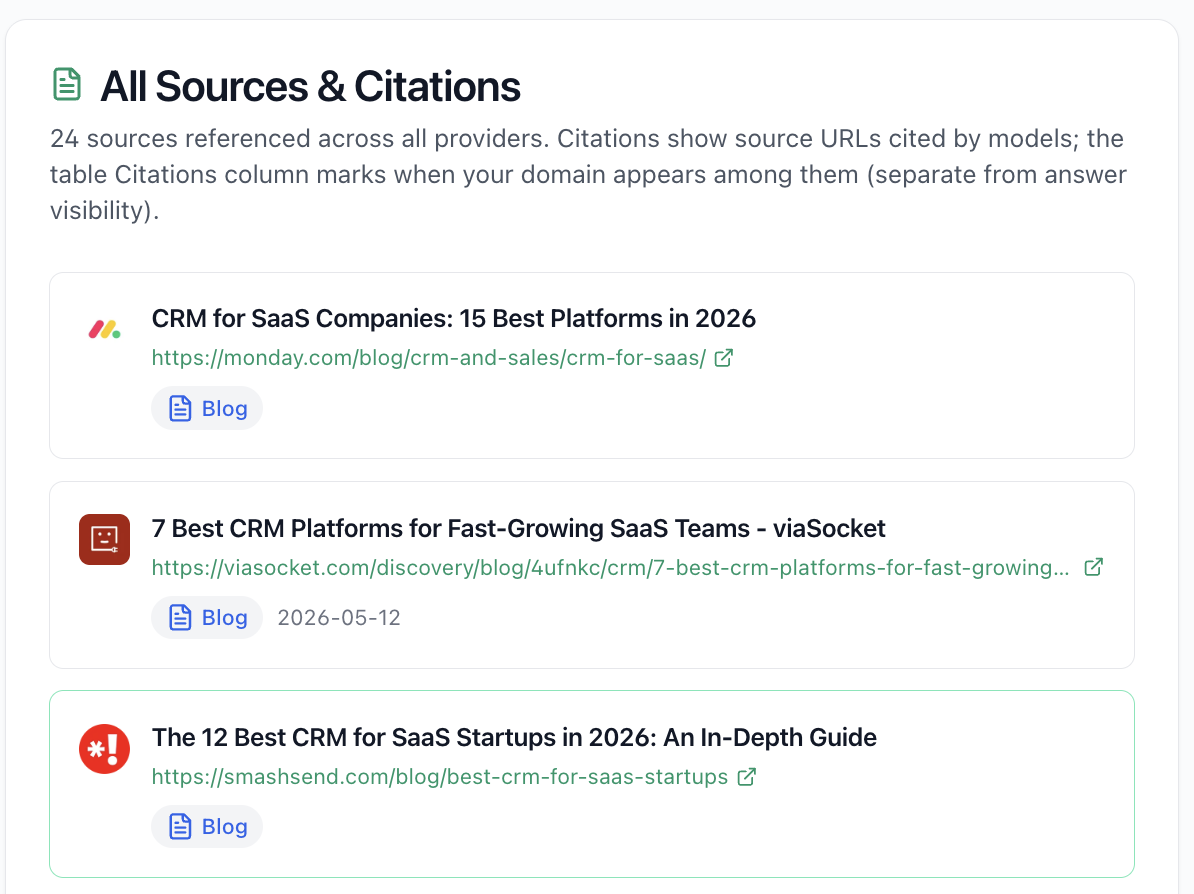
What you are seeing
Open the source list to see the pages, titles, content types, models, and prompts associated with each recorded citation.
Open full-size product screenshot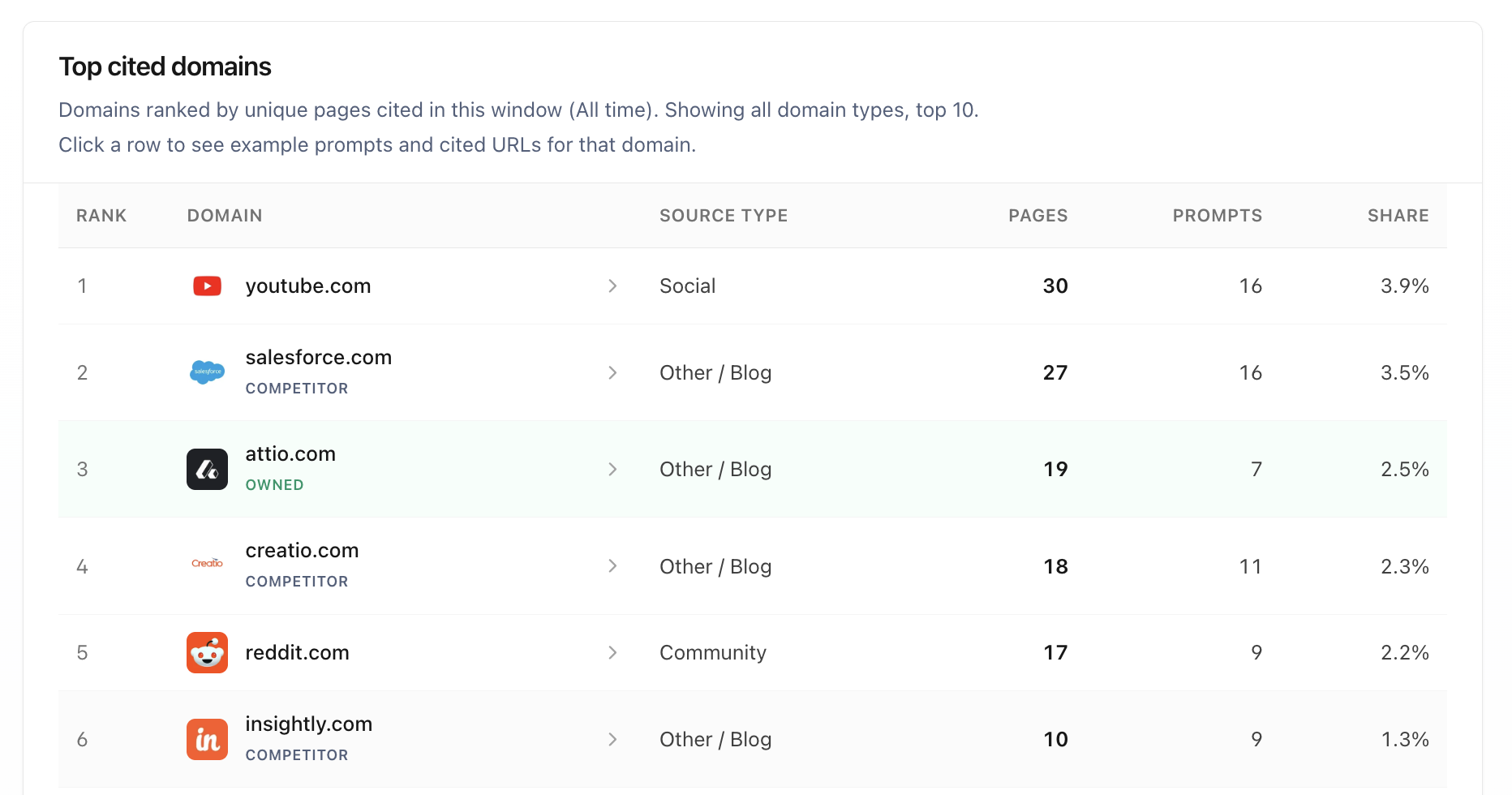
What you are seeing
See whether answers surface your own pages, competitor sites, communities, or independent sources before selecting a content or inclusion strategy.
Open full-size product screenshot
What you are seeing
Review the prompt, generated response, brand result, competitors, and available citations together rather than treating the URL as proof of influence.
Open full-size product screenshotHow it works
Use recurring source patterns to strengthen your content and presence where AI answers find evidence.
Focus on pages and domains that recur across the buyer prompts and models that matter to your market.
Create or update pages when your site lacks the clear answers, comparisons, or proof found in cited content.
Study cited competitor pages to identify useful topics, formats, and evidence your content does not yet cover.
Evaluate legitimate opportunities in trusted publications, directories, partnerships, and communities.
Monitor the original buyer questions to see whether source coverage and brand visibility change after the work ships.
Interpretation
The source record is a starting point for investigation. It should not be promoted into a claim the data cannot support.
Explain the source landscape behind client answers and turn it into transparent content or outreach research.
Coordinate owned content, digital PR, partnerships, and community work from the same prompt-level evidence.
Run a free audit to see which sources surface in your market and which prompt-level patterns deserve review.
We use cookies to enhance your experience, analyse site traffic and measure advertising. Read our Cookie Policy